Emergency & Storm Damage in Las Vegas, NV
If a July monsoon just pushed water through your ceiling and your tile roof looks perfectly fine from the street, you’re not imagining things — and you’re not alone. Las Vegas has a roof failure pattern unlike almost any other city in the country, and our Emergency & Storm Damage team has spent 11 years learning exactly how it works. Call us at (725) 400-0403 and Wayne Ford will assess your situation directly — no dispatcher, no subcontracted crew trying to figure out what they’re looking at.
Why Las Vegas Roof Repair Services Is Las Vegas’s Preferred Emergency & Storm Damage Company
Our local reputation in Las Vegas is built on 613 verified five-star reviews earned over 11 years of hands-on work — one of the most substantial review records in the Las Vegas roofing market. That’s not a number we throw around casually. Every one of those reviews came from a homeowner who watched Wayne show up, get on the roof, and do the work himself.
When a monsoon cell rolls through Summerlin or a wind event tears ridge caps off a home on the west side of the valley, response time is everything. We serve Las Vegas as a dedicated emergency operation — not as an add-on to a full-replacement schedule — which means we arrive equipped to tarp, document, and stabilize the same day. Homeowners in Henderson, North Las Vegas, and Spring Valley call us because they’ve seen the Google reviews and they want the person who earned them on their roof, not whoever happened to be available.
What happens when you call
- 1
A real person answersNo phone trees — you reach a local pro.
- 2
You get an upfront price rangeHonest numbers before anyone is dispatched.
- 3
A background-checked tech heads outLicensed & insured, dispatched right away.
- 4
You approve before work beginsNothing starts until you say go.
Our Emergency & Storm Damage Services in Las Vegas
Storm Damage Repair
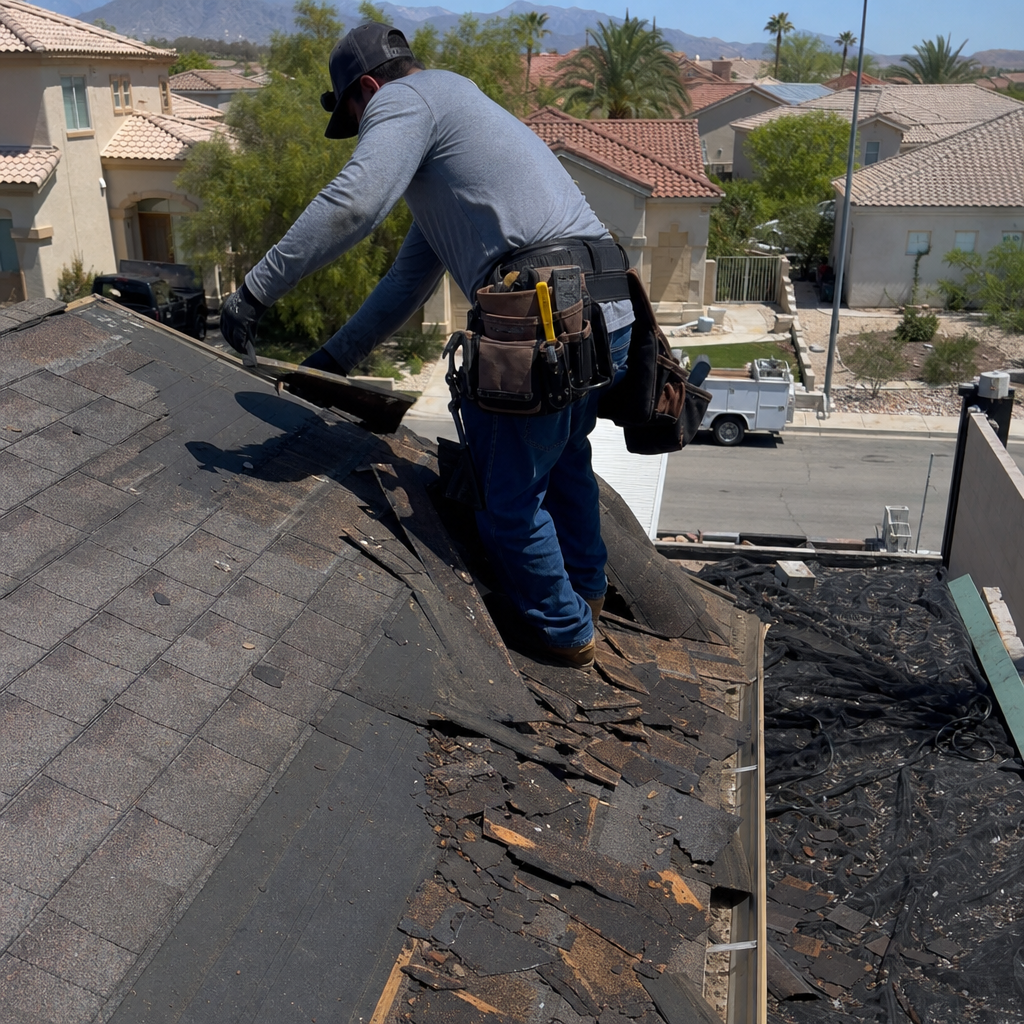
Las Vegas monsoon storms are fast and violent. A cell that drops two inches of rain in forty minutes on Rhodes Ranch will breach any underlayment weakness that’s been quietly building since the late 1990s. Our storm damage repair process starts with a full roof-plane inspection — not just the obvious leak point — because in a tile-dominant market, the water entry and the visible damage are rarely in the same place. We document everything with photos before we touch a tile, so your repair record is clean whether you’re paying out of pocket or filing a claim.

Emergency Tarp
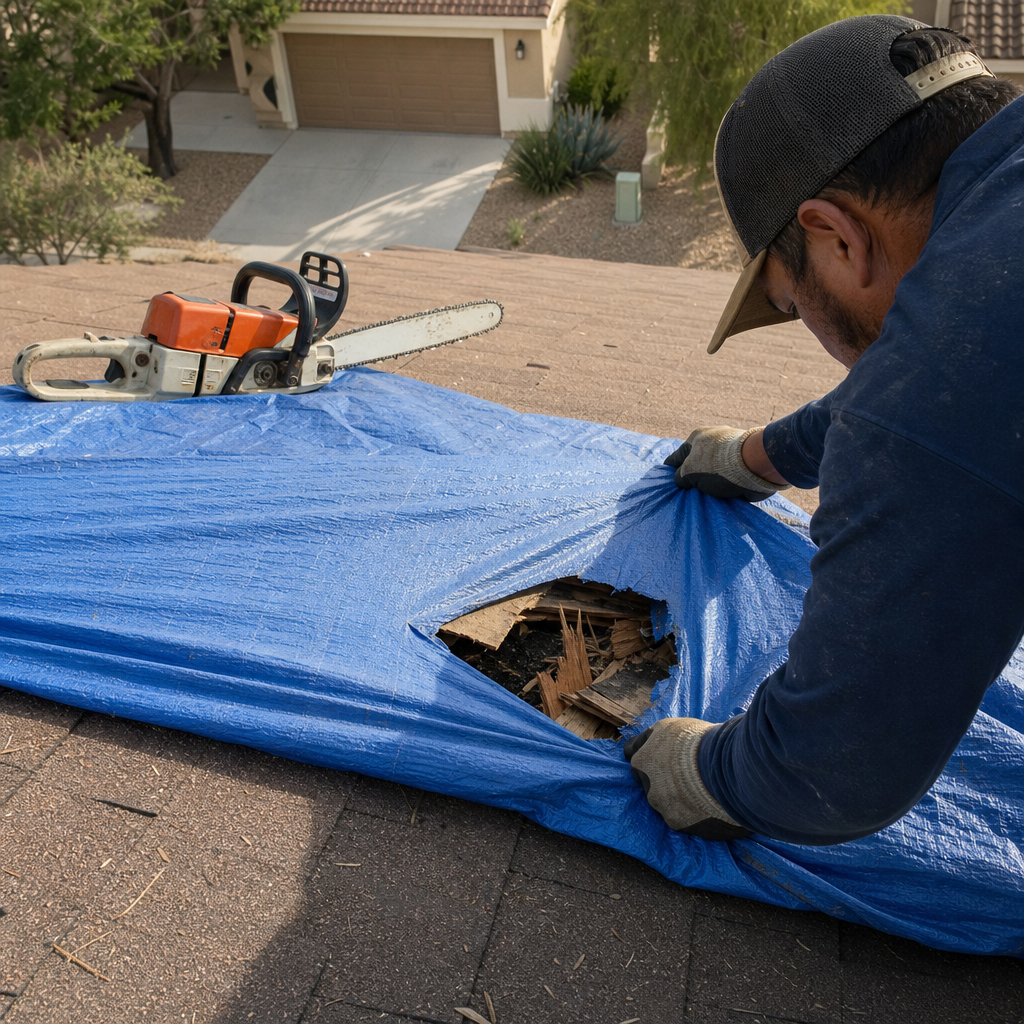
An emergency tarp is not a patch — it’s a properly installed moisture barrier sized and anchored to protect the entire exposed field until permanent repairs are scheduled. In Las Vegas, where concrete and clay tile roofs require careful tile removal before any underlayment work can begin, a correctly deployed tarp is what prevents a one-section failure from becoming a full interior flood. We carry the materials on every emergency call, and Wayne handles the tarp assessment personally so nothing gets missed in the rush.
After a July monsoon cell hit Rhodes Ranch, we responded to a 2001-build Mediterranean home where the homeowner had never had a single leak — and the concrete tile looked showroom-perfect from the street. When we pulled back a section near the hip ridge, the original 30-lb felt crumbled in our hands. Textbook “good tile, dead paper.” We tarped the exposed field that same afternoon, documented every failed underlayment section with photos for the insurance claim, and carefully lifted, inventoried, and staged the tile for re-stacking once the full underlayment re-lay was approved. That kind of job requires tile-removal skills this market demands — it’s nothing like a shingle tear-off.

Insurance Claims Support
Filing a storm damage claim in Las Vegas is harder than it sounds when the damage is invisible underlayment failure under intact-looking tile. Insurance adjusters who aren’t familiar with the local housing stock will sometimes look at pristine concrete tile and question the claim before they’ve seen the underlayment condition. We photograph every layer, write clear damage documentation, and have worked with adjusters across the Las Vegas valley long enough to know what carriers expect to see. We don’t manage your claim for you — but we give you the documentation that makes it defensible.

Wind Damage
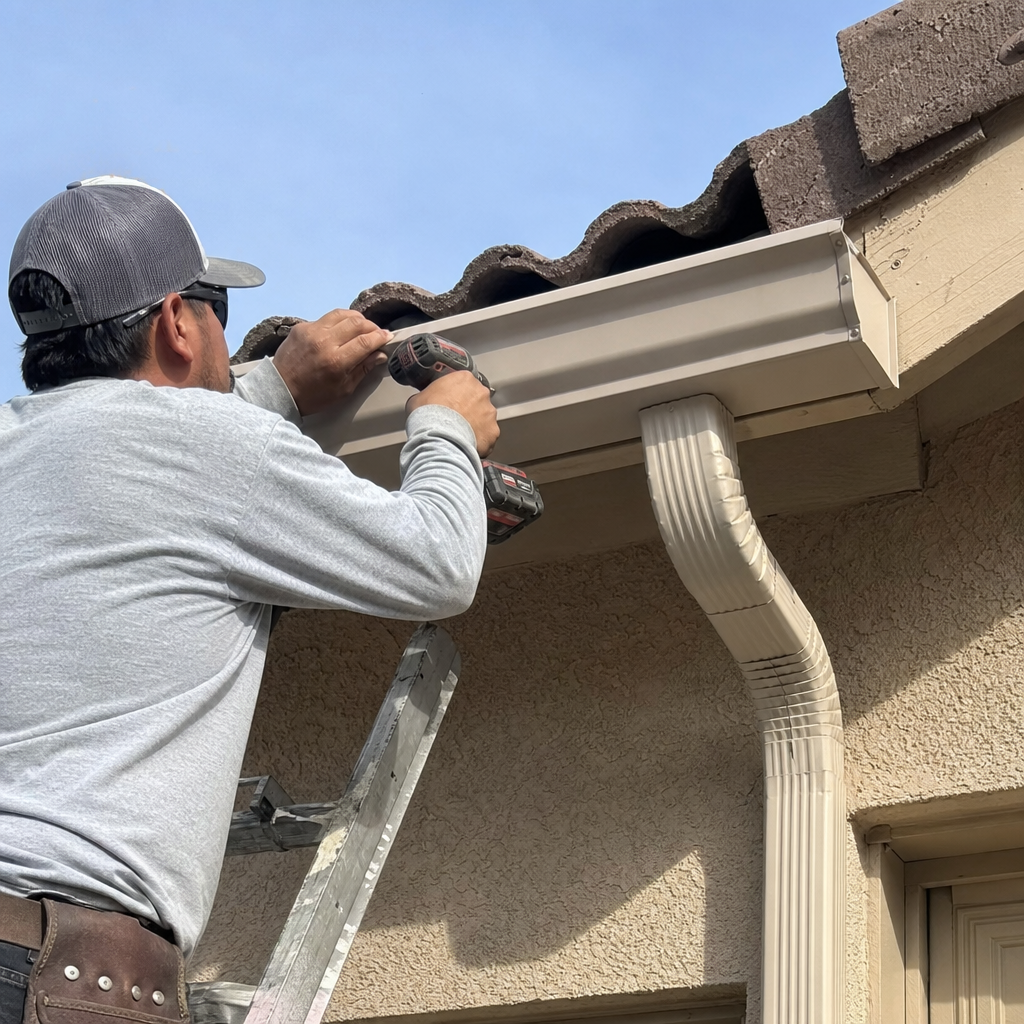
The same monsoon cells that flood flat-roof drains across master-planned communities also bring gusts strong enough to dislodge the mortar-set ridge and hip caps on 1995–2007 tile roofs throughout the valley. Once that cap is gone, you’ve lost the last weather barrier over underlayment that was already UV-baked for two decades. Wind damage calls in Las Vegas almost always reveal underlayment distress underneath — which is why we never limit a wind inspection to the displaced tiles alone. If you’re on the west side of Las Vegas near the Spring Mountains, expect that your ridge mortar has seen repeated stress from seasonal wind events.
Trusted Brands We Service in Las Vegas
For Las Vegas homeowners whose storm damage requires material replacement rather than just underlayment work, we work with seven manufacturers: GAF, CertainTeed, Owens Corning, IKO, Atlas, Tamko, and Boral. That range matters in this market because tile profiles and shingle specifications vary significantly across the different subdivision eras here. If a hip cap or ridge tile needs replacing on a 1998-build Summerlin home, we’re sourcing from suppliers who stock what that profile requires — not offering you a close-enough substitute because that’s what we happen to carry. Faster turnaround, better material match.
Common Emergency & Storm Damage Problems We See in Las Vegas Homes
- Silent underlayment failure beneath concrete and clay tile: Across Summerlin, Henderson, and North Las Vegas, the 1990s–2000s construction boom installed millions of square feet of tile over 30-lb felt that had a realistic service life of 15–20 years under Las Vegas’s 160°F+ roof-surface temperatures. The tile shows no distress — the felt beneath it has turned to powder. The first monsoon heavy enough to find the seams is the homeowner’s first warning sign, usually arriving as a ceiling stain.
- Flat-roof and low-pitch drainage overwhelm: Spanish and Mediterranean-style homes across master-planned communities frequently have flat or low-pitch sections with single-point drains sized for typical desert rainfall. When a convective monsoon cell drops an inch of rain in under twenty minutes, those drains can’t keep up, water ponds rapidly, and any membrane weakness fails under the hydrostatic pressure. Interior damage happens fast.
- Wind-lifted ridge and hip tiles exposing raw underlayment: Monsoon gusts routinely lift mortar-set ridge caps on Las Vegas tile roofs — caps that were installed over original felt now approaching the end of its service life. The exposed field beneath is raw and degraded, and Las Vegas’s afternoon convective storms often follow the wind event by hours. Same-day tarping is not optional in this scenario.
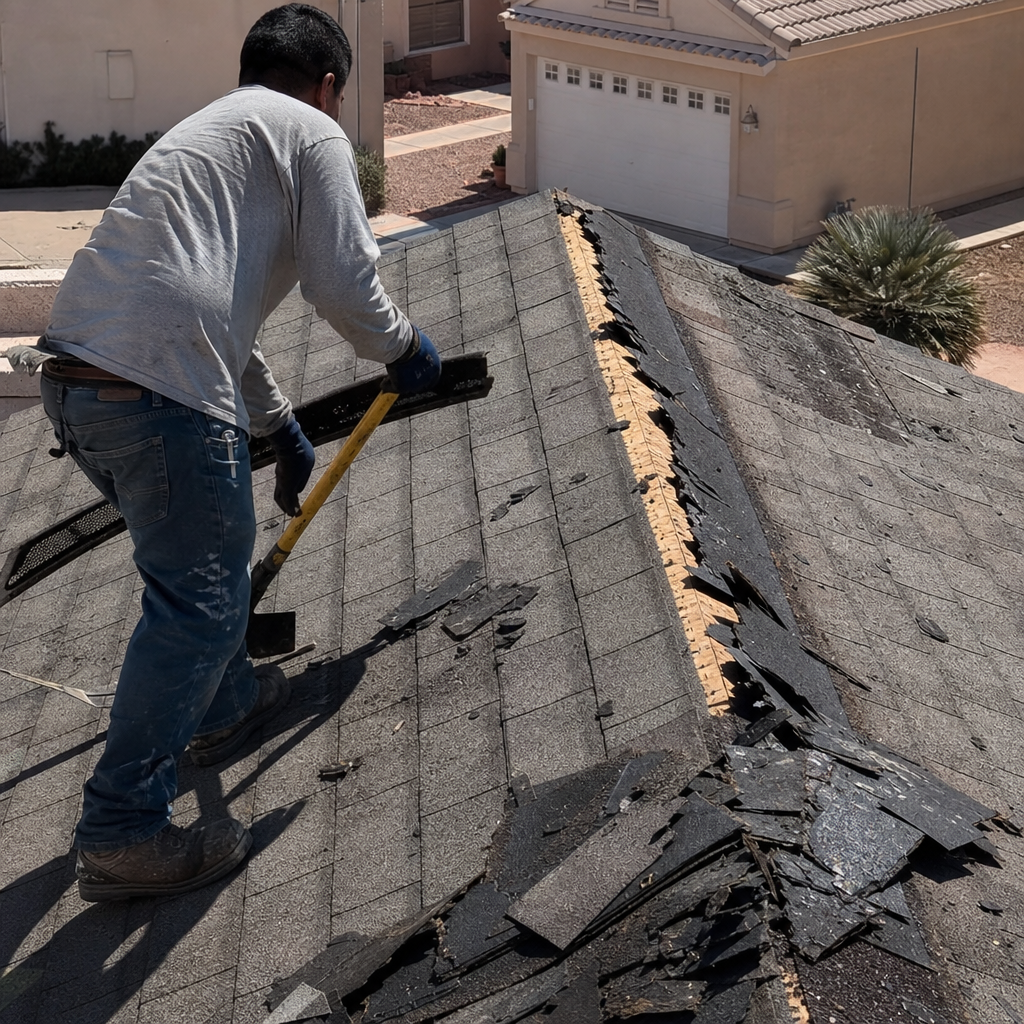
- Accelerated shingle granule loss on post-2000 homes: Las Vegas’s smaller percentage of asphalt-shingle roofs — found more often in older North Las Vegas neighborhoods and on lower-cost construction — experience granule loss at a faster rate than comparable markets because surface temperatures here routinely hit 170–175°F in summer. Granule loss accelerates UV degradation, and storm damage on a shingle roof that’s already baked for fifteen years is often more extensive than it looks on initial inspection.
Pricing for Emergency & Storm Damage in Las Vegas, NV
Emergency tarp installation in Las Vegas typically runs $350–$750 depending on roof pitch, access difficulty, and the size of the exposed area. Storm damage repair — tile re-setting, hip and ridge cap replacement, and localized underlayment patching — generally falls between $600 and $2,800 for contained damage areas. Wind damage repairs involving multiple displaced tiles and mortar re-bedding on a standard Las Vegas Mediterranean roof average $800–$2,200. If the inspection reveals widespread underlayment failure, a full underlayment re-lay on a tile roof runs $4,500–$12,000+ depending on square footage and tile profile complexity — that’s a separate scope from emergency response, and we’ll tell you clearly which situation you’re in before any work begins. Estimates are free. Call (725) 400-0403 and get a straight answer.
We Also Serve Cities Near Las Vegas
Our emergency and storm damage response covers the full Las Vegas valley, including Spring Valley, North Las Vegas, and Summerlin South. Whether you’re off Summerlin Parkway, near North Las Vegas’s older neighborhoods along Losee Road, or in a Spring Valley subdivision south of Charleston, we know the housing stock, the roof profiles, and the local failure patterns in each area. One crew, one point of contact, no hand-offs.
Serving Las Vegas, NV — Our Local Coverage Area
We’re based in the Las Vegas area and know this community well. Use the map below to see our service coverage — if you’re nearby, we can almost certainly help.
FAQs — Emergency & Storm Damage in Las Vegas
Your tile is fine. The problem is almost certainly the underlayment beneath it. Las Vegas’s dominant concrete and clay tile roofs were installed across Summerlin, Henderson, and North Las Vegas during the 1990s–2000s construction boom over 30-lb felt underlayment that has a realistic service life of 15–20 years under desert conditions. Roof-surface temperatures here hit 160–175°F in summer, which bakes felt into a brittle, cracked state long before the tile above it shows any deterioration. The tile can look showroom-new — roofers here call it “good tile, dead paper” — while the underlayment beneath has turned to powder. A monsoon storm with enough intensity to find the failed seams is typically the first event that pushes water inside, which is why many Las Vegas homeowners genuinely don’t know they have a roofing emergency until they see a ceiling stain. Call (725) 400-0403 and we’ll get eyes on the underlayment condition the same day.
It depends on how the damage is documented and how the adjuster interprets the cause of loss — but yes, it can, and proper documentation is the difference. If a wind event displaces ridge or hip tiles and that wind event is the proximate cause of water infiltration through already-degraded underlayment, many carriers will cover the full scope of the repair including the underlayment re-lay, not just the tile reset. We photograph every layer of the damage before anything is disturbed, and we write documentation that distinguishes acute storm damage from pre-existing wear — which is exactly what adjusters and carriers need to process a complete claim. Call us at (725) 400-0403 before you file so the documentation is built correctly from the start.
We treat emergency tarp calls as priority dispatch — when the monsoon season is active across the Las Vegas valley, we stage for emergency response because we know the pattern. Same-day deployment is our standard for active water infiltration situations. Wayne assesses the tarp placement personally because the scope of cover on a tile roof — where you can’t just lay a standard tarp without accounting for tile profiles and drainage paths — affects how well it protects the field until permanent repairs are scheduled. Don’t leave an exposed roof section overnight. Call (725) 400-0403 as soon as you discover the damage.
Emergency storm repair addresses immediate water infiltration — tarping exposed areas, resetting displaced tiles, sealing active breach points, and stabilizing the roof so no further interior damage occurs. It’s a same-day or next-day response scope. A full underlayment re-lay is a separate, planned project: all tiles are carefully lifted and inventoried, the degraded felt or synthetic underlayment is removed across the full roof plane, new underlayment is installed, and tiles are re-stacked and re-bedded. In Las Vegas’s tile market, the two scopes often occur sequentially — emergency response first, then the full re-lay once the claim is approved or the repair budget is confirmed. We’ll never sell you a full re-lay in the middle of an emergency. Tarp and stabilize first; then give you an honest assessment of what comes next.
Las Vegas does see hail — typically as part of the same convective monsoon cells that bring high wind and heavy rain, particularly in the July–September window. Hail damage on concrete and clay tile looks different from hail damage on asphalt shingles: instead of the granule-loss bruising visible on shingles, tile damage shows as cracking, chipping, or spider-fracture patterns that may not be immediately obvious from ground level. Cracked tiles are a direct water intrusion path, and in a market where the underlayment beneath is already UV-degraded, even a hairline tile fracture over failed felt is an active emergency. If you had a monsoon cell with hail pass over your Las Vegas neighborhood, a post-storm inspection is worth scheduling before the next rain event. Call (725) 400-0403 for a free assessment.
Reviewed by Wayne Ford, Owner & Lead Technician at Las Vegas Roof Repair Services, serving Las Vegas, NV since 2013.